

Heat Capacity Of Water Vapor
| H2o vapor (HtwoO) | |
|---|---|
 Invisible water vapor condenses to form | |
| Liquid land | Water |
| Solid country | Ice |
| Properties[1] | |
| Molecular formula | H2O |
| Molar mass | 18.01528(33) yard/mol |
| Melting point | 0.00 °C (273.15 1000)[2] |
| Humid point | 99.98 °C (373.xiii K)[ii] |
| specific gas constant | 461.5 J/(kg·One thousand) |
| Heat of vaporization | 2.27 MJ/kg |
| Oestrus capacity at 300 K | 1.864 kJ/(kg·K)[3] |
Water vapor, water vapour or aqueous vapor is the gaseous phase of water. It is one land of water within the hydrosphere. Water vapor can be produced from the evaporation or boiling of liquid water or from the sublimation of ice. H2o vapor is transparent, like most constituents of the temper.[4] Under typical atmospheric conditions, water vapor is continuously generated by evaporation and removed past condensation. It is less dumbo than about of the other constituents of air and triggers convection currents that can lead to clouds.
Being a component of Globe's hydrosphere and hydrologic cycle, it is specially abundant in Globe's atmosphere, where it acts as a greenhouse gas and warming feedback, contributing more than to full greenhouse result than non-condensable gases such equally carbon dioxide and marsh gas. Use of water vapor, every bit steam, has been important for cooking, and as a major component in energy production and transport systems since the industrial revolution.
Water vapor is a relatively common atmospheric constituent, present fifty-fifty in the solar atmosphere as well as every planet in the Solar System and many astronomical objects including natural satellites, comets and even large asteroids. Likewise the detection of extrasolar water vapor would indicate a similar distribution in other planetary systems. Water vapor can too be indirect evidence supporting the presence of extraterrestrial liquid water in the case of some planetary mass objects.
Backdrop [edit]
Evaporation [edit]
Whenever a h2o molecule leaves a surface and diffuses into a surrounding gas, it is said to have evaporated. Each individual water molecule which transitions betwixt a more than associated (liquid) and a less associated (vapor/gas) country does so through the absorption or release of kinetic energy. The aggregate measurement of this kinetic free energy transfer is divers as thermal energy and occurs only when there is differential in the temperature of the water molecules. Liquid water that becomes water vapor takes a parcel of heat with information technology, in a process called evaporative cooling.[5] The amount of h2o vapor in the air determines how frequently molecules will return to the surface. When a internet evaporation occurs, the torso of water volition undergo a net cooling directly related to the loss of h2o.
In the The states, the National Weather Service measures the actual rate of evaporation from a standardized "pan" open h2o surface outdoors, at various locations nationwide. Others practise likewise around the world. The U.s. data is collected and compiled into an annual evaporation map.[6] The measurements range from nether xxx to over 120 inches per twelvemonth. Formulas can be used for calculating the charge per unit of evaporation from a water surface such as a swimming pool.[7] [8] In some countries, the evaporation rate far exceeds the precipitation rate.
Evaporative cooling is restricted by atmospheric atmospheric condition. Humidity is the amount of water vapor in the air. The vapor content of air is measured with devices known equally hygrometers. The measurements are usually expressed every bit specific humidity or pct relative humidity. The temperatures of the atmosphere and the water surface make up one's mind the equilibrium vapor pressure; 100% relative humidity occurs when the partial pressure level of water vapor is equal to the equilibrium vapor pressure. This condition is often referred to as complete saturation. Humidity ranges from 0 grams per cubic metre in dry out air to 30 grams per cubic metre (0.03 ounce per cubic foot) when the vapor is saturated at xxx °C.[ix]


Sublimation [edit]
Sublimation is the process by which h2o molecules directly leave the surface of water ice without beginning becoming liquid water. Sublimation accounts for the irksome mid-winter disappearance of ice and snowfall at temperatures too depression to crusade melting. Antarctica shows this effect to a unique degree considering information technology is past far the continent with the lowest rate of precipitation on Globe. As a result, there are large areas where millennial layers of snow have sublimed, leaving behind whatever not-volatile materials they had independent. This is extremely valuable to certain scientific disciplines, a dramatic example being the drove of meteorites that are left exposed in unparalleled numbers and excellent states of preservation.
Sublimation is important in the preparation of certain classes of biological specimens for scanning electron microscopy. Typically the specimens are prepared by cryofixation and freeze-fracture, subsequently which the broken surface is freeze-etched, being eroded by exposure to vacuum till it shows the required level of detail. This technique tin can display protein molecules, organelle structures and lipid bilayers with very depression degrees of distortion.
Condensation [edit]
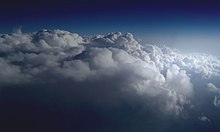
Clouds, formed by condensed water vapor
Water vapor volition only condense onto some other surface when that surface is libation than the dew signal temperature, or when the water vapor equilibrium in air has been exceeded. When water vapor condenses onto a surface, a net warming occurs on that surface.[10] The water molecule brings heat energy with it. In turn, the temperature of the atmosphere drops slightly.[11] In the atmosphere, condensation produces clouds, fog and precipitation (usually only when facilitated by cloud condensation nuclei). The dew bespeak of an air packet is the temperature to which it must cool before h2o vapor in the air begins to condense. Condensation in the atmosphere forms cloud droplets.
Likewise, a internet condensation of water vapor occurs on surfaces when the temperature of the surface is at or below the dew point temperature of the atmosphere. Deposition is a phase transition carve up from condensation which leads to the direct formation of ice from water vapor. Frost and snow are examples of deposition.
There are several mechanisms of cooling by which condensation occurs: i) Direct loss of estrus by conduction or radiation. 2) Cooling from the drop in air pressure which occurs with uplift of air, also known as adiabatic cooling. Air tin can exist lifted by mountains, which deflect the air upward, by convection, and by cold and warm fronts. 3) Advective cooling - cooling due to horizontal move of air.
Importance and Uses [edit]
- Provides h2o for plants and animals: Water vapour gets converted to rain and snow that serve as a natural source of water for plants and animals.
- Controls evaporation: Backlog water vapor in the air decreases the rate of evaporation.
- Determines climatic atmospheric condition: Backlog water vapor in the air produces rain, fog, snow etc. Hence, it determines climatic weather condition.
Chemical reactions [edit]
A number of chemical reactions take water as a product. If the reactions have identify at temperatures higher than the dew point of the surrounding air the water will exist formed equally vapor and increase the local humidity, if below the dew bespeak local condensation will occur. Typical reactions that result in h2o germination are the burning of hydrogen or hydrocarbons in air or other oxygen containing gas mixtures, or as a result of reactions with oxidizers.
In a similar fashion other chemical or physical reactions can accept place in the presence of water vapor resulting in new chemicals forming such as rust on iron or steel, polymerization occurring (certain polyurethane foams and cyanoacrylate glues cure with exposure to atmospheric humidity) or forms changing such every bit where anhydrous chemicals may blot enough vapor to course a crystalline structure or alter an existing one, sometimes resulting in characteristic color changes that can be used for measurement.
Measurement [edit]
Measuring the quantity of h2o vapor in a medium can exist washed directly or remotely with varying degrees of accuracy. Remote methods such electromagnetic absorption are possible from satellites above planetary atmospheres. Directly methods may use electronic transducers, moistened thermometers or hygroscopic materials measuring changes in physical backdrop or dimensions.
| medium | temperature range (degC) | measurement uncertainty | typical measurement frequency | system price | notes | |
|---|---|---|---|---|---|---|
| Sling psychrometer | air | −10 to 50 | low to moderate | hourly | low | |
| Satellite-based spectroscopy | air | −80 to 60 | low | very loftier | ||
| Capacitive sensor | air/gases | −40 to fifty | moderate | two to 0.05 Hz | medium | prone to condign saturated/contaminated over time |
| Warmed capacitive sensor | air/gases | −15 to 50 | moderate to low | 2 to 0.05 Hz (temp dependant) | medium to loftier | prone to becoming saturated/contaminated over time |
| Resistive sensor | air/gases | −10 to 50 | moderate | lx seconds | medium | prone to contamination |
| Lithium chloride dewcell | air | −xxx to 50 | moderate | continuous | medium | come across dewcell |
| Cobalt(2) chloride | air/gases | 0 to 50 | high | 5 minutes | very depression | often used in Humidity indicator card |
| Assimilation spectroscopy | air/gases | moderate | high | |||
| Aluminum oxide | air/gases | moderate | medium | encounter Moisture analysis | ||
| Silicon oxide | air/gases | moderate | medium | see Moisture analysis | ||
| Piezoelectric sorption | air/gases | moderate | medium | meet Moisture analysis | ||
| Electrolytic | air/gases | moderate | medium | run across Wet analysis | ||
| Pilus tension | air | 0 to twoscore | high | continuous | low to medium | Afflicted by temperature. Adversely affected by prolonged high concentrations |
| Nephelometer | air/other gases | depression | very high | |||
| Goldbeater's skin (Cow Peritoneum) | air | −twenty to 30 | moderate (with corrections) | slow, slower at lower temperatures | low | ref:WMO Guide to Meteorological Instruments and Methods of Ascertainment No. 8 2006, (pages 1.12–i) |
| Lyman-alpha | high frequency | loftier | http://amsglossary.allenpress.com/glossary/search?id=lyman-alpha-hygrometer1 Requires frequent scale | |||
| Gravimetric Hygrometer | very low | very loftier | often called primary source, national independent standards developed in US,Uk,Eu & Nippon | |||
| medium | temperature range (degC) | measurement uncertainty | typical measurement frequency | organisation cost | notes |
Touch on on air density [edit]
H2o vapor is lighter or less dense than dry air.[12] [13] At equivalent temperatures it is buoyant with respect to dry out air, whereby the density of dry air at standard temperature and pressure (273.15 1000, 101.325 kPa) is 1.27 g/L and water vapor at standard temperature has a vapor pressure of 0.vi kPa and the much lower density of 0.0048 yard/L.
Calculations [edit]
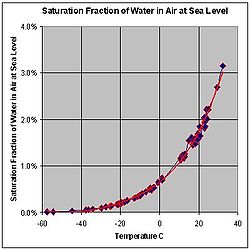
Water vapor and dry air density calculations at 0 °C:
- The molar mass of water is 18.02 grand/mol, every bit calculated from the sum of the diminutive masses of its elective atoms.
- The average tooth mass of air (approx. 78% nitrogen, Due northii; 21% oxygen, O2; 1% other gases) is 28.57 g/mol at standard temperature and pressure (STP).
- Obeying Avogadro's Law and the ideal gas law, moist air will have a lower density than dry air. At max. saturation (i. e. rel. humidity = 100% at 0 °C) the density volition go down to 28.51 g/mol.
- STP conditions imply a temperature of 0 °C, at which the ability of water to get vapor is very restricted. Its concentration in air is very low at 0 °C. The cherry line on the chart to the right is the maximum concentration of h2o vapor expected for a given temperature. The h2o vapor concentration increases significantly as the temperature rises, approaching 100% (steam, pure water vapor) at 100 °C. All the same the departure in densities between air and water vapor would still exist (0.598 vs. 1.27 thousand/L).
At equal temperatures [edit]
At the same temperature, a column of dry out air will be denser or heavier than a column of air containing any water vapor, the tooth mass of diatomic nitrogen and diatomic oxygen both beingness greater than the molar mass of h2o. Thus, whatever volume of dry air volition sink if placed in a larger book of moist air. Also, a volume of moist air will ascension or be buoyant if placed in a larger region of dry air. Equally the temperature rises the proportion of water vapor in the air increases, and its buoyancy will increase. The increase in buoyancy tin can have a significant atmospheric impact, giving rise to powerful, moisture rich, upward air currents when the air temperature and body of water temperature reaches 25 °C or above. This phenomenon provides a meaning driving force for cyclonic and anticyclonic weather systems (typhoons and hurricanes).
Respiration and breathing [edit]
Water vapor is a past-production of respiration in plants and animals. Its contribution to the pressure, increases as its concentration increases. Its fractional force per unit area contribution to air pressure increases, lowering the fractional force per unit area contribution of the other atmospheric gases (Dalton's Law). The total air force per unit area must remain constant. The presence of h2o vapor in the air naturally dilutes or displaces the other air components as its concentration increases.
This can have an effect on respiration. In very warm air (35 °C) the proportion of water vapor is large plenty to requite ascension to the stuffiness that can be experienced in humid jungle weather or in poorly ventilated buildings.
Lifting gas [edit]
Water vapor has lower density than that of air and is therefore buoyant in air but has lower vapor pressure than that of air. When water vapor is used as a lifting gas by a thermal airship the h2o vapor is heated to course steam so that its vapor pressure is greater than the surrounding air pressure in order to maintain the shape of a theoretical "steam balloon", which yields approximately 60% the lift of helium and twice that of hot air.[fourteen]
General discussion [edit]
The amount of h2o vapor in an temper is constrained by the restrictions of fractional pressures and temperature. Dew bespeak temperature and relative humidity act as guidelines for the process of water vapor in the h2o wheel. Energy input, such every bit sunlight, tin trigger more evaporation on an ocean surface or more sublimation on a clamper of ice on peak of a mount. The balance betwixt condensation and evaporation gives the quantity called vapor partial pressure.
The maximum partial force per unit area (saturation pressure) of water vapor in air varies with temperature of the air and water vapor mixture. A variety of empirical formulas exist for this quantity; the most used reference formula is the Goff-Gratch equation for the SVP over liquid water below nil degrees Celsius:
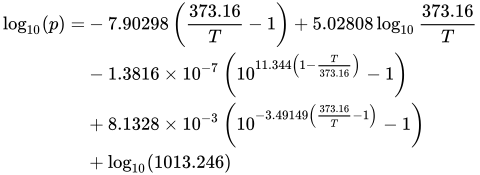
where T, temperature of the moist air, is given in units of kelvin, and p is given in units of millibars (hectopascals).
The formula is valid from almost −l to 102 °C; nevertheless in that location are a very limited number of measurements of the vapor pressure level of water over supercooled liquid water. There are a number of other formulae which tin be used.[fifteen]
Nether certain weather, such every bit when the boiling temperature of water is reached, a net evaporation will e'er occur during standard atmospheric weather regardless of the percent of relative humidity. This firsthand process volition dispel massive amounts of water vapor into a cooler temper.
Exhaled air is almost fully at equilibrium with h2o vapor at the body temperature. In the common cold air the exhaled vapor apace condenses, thus showing up as a fog or mist of h2o droplets and equally condensation or frost on surfaces. Forcibly condensing these water droplets from exhaled jiff is the basis of exhaled breath condensate, an evolving medical diagnostic test.
Controlling water vapor in air is a key business organization in the heating, ventilating, and air-conditioning (HVAC) industry. Thermal comfort depends on the moist air conditions. Non-homo comfort situations are called refrigeration, and also are affected by water vapor. For example, many food stores, like supermarkets, use open chiller cabinets, or food cases, which can significantly lower the water vapor pressure (lowering humidity). This exercise delivers several benefits as well every bit issues.
In Earth's atmosphere [edit]
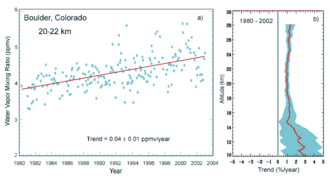
Evidence for increasing amounts of stratospheric h2o vapor over time in Bedrock, Colorado.
Gaseous water represents a small only environmentally meaning constituent of the temper. The percentage of water vapor in surface air varies from 0.01% at -42 °C (-44 °F)[16] to 4.24% when the dew betoken is 30 °C (86 °F).[17] Over 99% of atmospheric water is in the form of vapour, rather than liquid water or ice,[18] and approximately 99.13% of the water vapour is contained in the troposphere. The condensation of h2o vapor to the liquid or ice phase is responsible for clouds, pelting, snow, and other precipitation, all of which count among the near significant elements of what we experience as weather. Less obviously, the latent heat of vaporization, which is released to the atmosphere whenever condensation occurs, is ane of the most important terms in the atmospheric energy upkeep on both local and global scales. For example, latent heat release in atmospheric convection is directly responsible for powering destructive storms such equally tropical cyclones and severe thunderstorms. H2o vapor is an important greenhouse gas[19] [20] owing to the presence of the hydroxyl bond which strongly absorbs in the infra-red.
Water vapor is the "working medium" of the atmospheric thermodynamic engine which transforms estrus energy from sun irradiation into mechanical free energy in the course of winds. Transforming thermal energy into mechanical energy requires an upper and a lower temperature level, as well equally a working medium which shuttles along and back between both. The upper temperature level is given by the soil or water surface of the earth, which absorbs the incoming sun radiations and warms up, evaporating water. The moist and warm air at the footing is lighter than its surroundings and rises upwards to the upper limit of the troposphere. In that location the h2o molecules radiate their thermal energy into outer space, cooling down the surrounding air. The upper atmosphere constitutes the lower temperature level of the atmospheric thermodynamic engine. The water vapor in the now cold air condenses out and falls down to the basis in the grade of pelting or snow. The now heavier cold and dry air sinks downward to ground as well; the atmospheric thermodynamic engine thus establishes a vertical convection, which transports rut from the ground into the upper temper, where the water molecules can radiate it to outer space. Due to the earth'south rotation and the resulting Coriolis forces, this vertical atmospheric convection is as well converted into a horizontal convection, in the class of cyclones and anticyclones, which transport the water evaporated over the oceans into the interior of the continents, enabling vegetation to grow.[21]
Water in World'south atmosphere is not merely beneath its humid bespeak (100 °C), only at altitude it goes beneath its freezing point (0 °C), due to water'southward highly polar attraction. When combined with its quantity, h2o vapor then has a relevant dew point and frost point, unlike e. g., carbon dioxide and methyl hydride. Water vapor thus has a scale height a fraction of that of the majority atmosphere,[22] [23] [24] as the water condenses and exits, primarily in the troposphere, the lowest layer of the atmosphere.[25] Carbon dioxide (CO2) and methane, beingness well-mixed in the temper, tend to rise above water vapour. The absorption and emission of both compounds contribute to Earth's emission to space, and thus the planetary greenhouse effect.[23] [26] [27] This greenhouse forcing is directly observable, via distinct spectral features versus water vapor, and observed to exist rising with ascent COii levels.[28] Conversely, calculation water vapor at high altitudes has a disproportionate touch, which is why jet traffic[29] [thirty] [31] has a disproportionately loftier warming effect. Oxidation of methane is as well a major source of water vapour in the stratosphere,[32] and adds virtually 15% to methane's global warming event.[33]
In the absenteeism of other greenhouse gases, Earth's h2o vapor would condense to the surface;[34] [35] [36] this has likely happened, possibly more than once. Scientists thus distinguish between non-condensable (driving) and condensable (driven) greenhouse gases, i.e., the above water vapor feedback.[37] [20] [19]
Fog and clouds form through condensation effectually deject condensation nuclei. In the absence of nuclei, condensation will merely occur at much lower temperatures. Under persistent condensation or degradation, cloud aerosol or snowflakes form, which precipitate when they reach a critical mass.
Atmospheric concentration of h2o vapour is highly variable between locations and times, from 10 ppmv in the coldest air to v% (50 000 ppmv) in humid tropical air,[38] and tin can be measured with a combination of land observations, weather balloons and satellites.[39] The h2o content of the atmosphere as a whole is constantly depleted by precipitation. At the aforementioned time it is constantly replenished by evaporation, most prominently from oceans, lakes, rivers, and moist earth. Other sources of atmospheric water include combustion, respiration, volcanic eruptions, the transpiration of plants, and various other biological and geological processes. At any given time there is about 1.29 10 x16 litres (3.4 10 10xv gal.) of water in the atmosphere. The atmosphere holds ane part in 2500 of the fresh water, and one role in 100,000 of the total h2o on Earth.[twoscore] The mean global content of h2o vapor in the atmosphere is roughly sufficient to encompass the surface of the planet with a layer of liquid water about 25 mm deep.[41] [42] [43] The hateful annual precipitation for the planet is about 1 metre, a comparing which implies a rapid turnover of water in the air – on average, the residence time of a water molecule in the troposphere is about nine to x days.[43]
Global mean h2o vapour is about 0.25% of the atmosphere by mass and also varies seasonally, in terms of contribution to atmospheric pressure between two.62 hPa in July and ii.33 hPa in December.[44] IPCC AR6 expresses medium confidence in increase of full h2o vapour at near 1-2% per decade;[45] it is expected to increment by around seven% per °C of warming.[41]
Episodes of surface geothermal activeness, such as volcanic eruptions and geysers, release variable amounts of h2o vapor into the atmosphere. Such eruptions may exist large in human terms, and major explosive eruptions may inject exceptionally large masses of water exceptionally high into the atmosphere, just as a pct of total atmospheric water, the part of such processes is lilliputian. The relative concentrations of the various gases emitted by volcanoes varies considerably according to the site and co-ordinate to the particular event at any one site. However, water vapor is consistently the commonest volcanic gas; equally a dominion, it comprises more than 60% of full emissions during a subaerial eruption.[46]
Atmospheric water vapor content is expressed using various measures. These include vapor pressure, specific humidity, mixing ratio, dew point temperature, and relative humidity.
Radar and satellite imaging [edit]
These maps prove the boilerplate amount of h2o vapor in a column of atmosphere in a given month.(click for more than detail)

MODIS/Terra global mean atmospheric h2o vapor in atm-cm (centimeters of water in an atmospheric column if it condensed)
Because water molecules absorb microwaves and other radio moving ridge frequencies, water in the atmosphere attenuates radar signals.[47] In addition, atmospheric h2o will reflect and refract signals to an extent that depends on whether it is vapor, liquid or solid.
Generally, radar signals lose strength progressively the further they travel through the troposphere. Dissimilar frequencies attenuate at different rates, such that some components of air are opaque to some frequencies and transparent to others. Radio waves used for broadcasting and other communication experience the same result.
Water vapor reflects radar to a lesser extent than do water's other ii phases. In the form of drops and ice crystals, h2o acts equally a prism, which it does not do every bit an individual molecule; all the same, the beingness of h2o vapor in the atmosphere causes the atmosphere to act equally a giant prism.[48]
A comparing of GOES-12 satellite images shows the distribution of atmospheric h2o vapor relative to the oceans, clouds and continents of the World. Vapor surrounds the planet but is unevenly distributed. The image loop on the correct shows monthly average of water vapor content with the units are given in centimeters, which is the precipitable water or equivalent amount of water that could exist produced if all the water vapor in the cavalcade were to condense. The lowest amounts of water vapor (0 centimeters) appear in yellowish, and the highest amounts (half dozen centimeters) appear in dark blue. Areas of missing information appear in shades of gray. The maps are based on data nerveless by the Moderate Resolution Imaging Spectroradiometer (MODIS) sensor on NASA'south Aqua satellite. The most noticeable pattern in the time series is the influence of seasonal temperature changes and incoming sunlight on water vapor. In the tropics, a ring of extremely humid air wobbles north and s of the equator every bit the seasons change. This band of humidity is part of the Intertropical Convergence Zone, where the easterly trade winds from each hemisphere converge and produce near-daily thunderstorms and clouds. Farther from the equator, h2o vapor concentrations are loftier in the hemisphere experiencing summer and low in the one experiencing winter. Another pattern that shows up in the time series is that h2o vapor amounts over state areas decrease more in winter months than adjacent ocean areas do. This is largely because air temperatures over land drop more than in the winter than temperatures over the ocean. Water vapor condenses more rapidly in colder air.[49]
Equally water vapor absorbs light in the visible spectral range, its absorption tin be used in spectroscopic applications (such as DOAS) to determine the amount of h2o vapor in the temper. This is done operationally, eastward.thousand. from the Global Ozone Monitoring Experiment (GOME) spectrometers on ERS (GOME) and MetOp (GOME-ii).[50] The weaker water vapor absorption lines in the blue spectral range and farther into the UV up to its dissociation limit around 243 nm are generally based on quantum mechanical calculations[51] and are simply partly confirmed by experiments.[52]
Lightning generation [edit]
H2o vapor plays a central function in lightning production in the temper. From cloud physics, commonly clouds are the real generators of static charge as found in Earth's atmosphere. The ability of clouds to hold massive amounts of electric energy is direct related to the corporeality of water vapor nowadays in the local organization.
The amount of water vapor directly controls the permittivity of the air. During times of low humidity, static discharge is quick and easy. During times of college humidity, fewer static discharges occur. Permittivity and capacitance work hand in paw to produce the megawatt outputs of lightning.[53]
After a cloud, for case, has started its way to becoming a lightning generator, atmospheric water vapor acts as a substance (or insulator) that decreases the ability of the cloud to belch its electrical energy. Over a sure amount of time, if the deject continues to generate and store more static electricity, the barrier that was created past the atmospheric water vapor volition ultimately break down from the stored electrical potential energy.[54] This energy will be released to a local oppositely charged region, in the course of lightning. The strength of each discharge is directly related to the atmospheric permittivity, capacitance, and the source's charge generating ability.[55]
[edit]
H2o vapor is common in the Solar System and by extension, other planetary systems. Its signature has been detected in the atmospheres of the Sun, occurring in sunspots. The presence of water vapor has been detected in the atmospheres of all seven extraterrestrial planets in the solar system, the Earth'southward Moon,[56] and the moons of other planets,[ which? ] although typically in only trace amounts.

Creative person's illustration of the signatures of h2o in exoplanet atmospheres detectable by instruments such as the Hubble Space Telescope.[58]
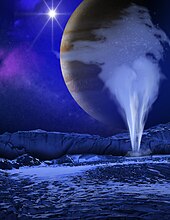
Geological formations such as cryogeysers are thought to exist on the surface of several icy moons ejecting water vapor due to tidal heating and may indicate the presence of substantial quantities of subsurface water. Plumes of water vapor have been detected on Jupiter'due south moon Europa and are similar to plumes of h2o vapor detected on Saturn'due south moon Enceladus.[57] Traces of h2o vapor take also been detected in the stratosphere of Titan.[59] Water vapor has been found to be a major constituent of the temper of dwarf planet, Ceres, largest object in the asteroid chugalug[60] The detection was made by using the far-infrared abilities of the Herschel Space Observatory.[61] The finding is unexpected because comets, not asteroids, are typically considered to "sprout jets and plumes." Co-ordinate to 1 of the scientists, "The lines are becoming more and more blurred between comets and asteroids."[61] Scientists studying Mars hypothesize that if water moves about the planet, information technology does then every bit vapor.[62]
The luminescence of comet tails comes largely from h2o vapor. On approach to the Dominicus, the water ice many comets carry sublimes to vapor. Knowing a comet's distance from the sun, astronomers may deduce the comet'due south h2o content from its brilliance.[63]
Water vapor has as well been confirmed outside the Solar Organization. Spectroscopic analysis of Hard disk 209458 b, an extrasolar planet in the constellation Pegasus, provides the get-go bear witness of atmospheric water vapor beyond the Solar System. A star called CW Leonis was found to accept a ring of vast quantities of water vapor circling the aging, massive star. A NASA satellite designed to study chemicals in interstellar gas clouds, made the discovery with an onboard spectrometer. Most likely, "the water vapor was vaporized from the surfaces of orbiting comets."[64] Other exoplanets with evidence of water vapor include HAT-P-11b and K2-18b.[65] [66]
See likewise [edit]
- Air density
- Atmospheric river
- Humid point
- Condensation in droplets dynamics
- Degradation
- Earth's atmosphere
- Eddy covariance
- Equation of state
- Evaporative cooler
- Fog
- Frost
- Gas laws
- Gibbs free energy
- Gibbs stage rule
- Greenhouse gas
- Heat capacity
- Heat of vaporization
- Humidity
- Hygrometer
- Ideal gas
- Kinetic theory of gases
- Latent estrus
- Latent heat flux
- Microwave radiometer
- Phase of matter
- Saturation vapor density
- Steam
- Sublimation
- Superheating
- Supersaturation
- Thermodynamics
- Troposphere
- Vapor force per unit area
References [edit]
- ^ Lide (1992)
- ^ a b SODDI Vienna Standard Hateful Ocean Water (VSMOW), used for scale, melts at 273.1500089(10) K (0.000089(10) °C, and boils at 373.1339 [Kelvin|Yard} (99.9839 °C)
- ^ "Water Vapor – Specific Heat". Retrieved May xv, 2012.
- ^ "What is H2o Vapor?". Retrieved August 28, 2012.
- ^ Schroeder (2000), p. 36
- ^ "Geotechnical, Rock and Water Resources Library - Abound Resources - Evaporation". Archived from the original on Apr 12, 2008. Retrieved April 7, 2008.
- ^ "swimming, pool, adding, evaporation, h2o, thermal, temperature, humidity, vapor, excel". Retrieved February 26, 2016.
- ^ "Summary of Results of all Pool Evaporation Rate Studies". R. L. Martin & Associates. Archived from the original on March 24, 2008.
- ^ "climate - meteorology". Encyclopædia Britannica . Retrieved February 26, 2016.
- ^ Held, Isaac M.; Soden, Brian J. (Nov 2000). "Watervaporfeedback Andglobalwarming". Annual Review of Energy and the Environment. 25 (1): 441–475. doi:10.1146/annurev.energy.25.1.441. ISSN 1056-3466. Archived from the original on June 17, 2021. Retrieved June 7, 2021.
- ^ Schroeder (2000), p. 19
- ^ Williams, Jack (Baronial five, 2013). "Why dry air is heavier than humid air". The Washington Post . Retrieved Dec 28, 2014.
- ^ "Humidity 101". World Water rescue Foundation. Archived from the original on April 16, 2013. Retrieved December 28, 2014.
- ^ Goodey, Thomas J. "Steam Balloons and Steam Airships". Retrieved Baronial 26, 2010.
- ^ "H2o Vapor Pressure level Formulations". Retrieved February 26, 2016.
- ^ McElroy (2002), p. 34, Fig. 4.3a
- ^ McElroy (2002), p. 36 example iv.1
- ^ "Atmospheric Water Vapor". Remote Sensing Systems . Retrieved August 22, 2021.
- ^ a b Lacis, A. et al., The role of long-lived greenhouse gases as principal LW command knob that governs the global surface temperature for past and future climatic change, Tellus B, vol. 65 p. 19734, 2013
- ^ a b "Properties". American Chemic Society . Retrieved Feb 26, 2016.
- ^ https://web.stanford.edu/~ajlucas/The%20Atmosphere%20as%20a%20Heat%20Engine.pdf [ expressionless link ]
- ^ Bruce Fifty. Gary. "Ch#5". Retrieved February 26, 2016.
- ^ a b "The Carbon Dioxide Greenhouse Consequence". Archived from the original on November 11, 2016. Retrieved February 26, 2016.
- ^ Weaver & Ramanathan (1995)
- ^ Norris, K. (Dec two, 2013). "Icy Surprise". Aviation Week & Space Applied science. 175 (41): 30.
22,000 ft., which is considered the upper limit for clouds containing supercooled liquid water
- ^ "Climate scientists ostend elusive tropospheric hot spot". ARC Center of Excellence for Climate System Science. May fourteen, 2015. Archived from the original on April 4, 2019. Retrieved May 17, 2015.
- ^ Sherwood, South; Nishant, N (May 11, 2015). "Atmospheric changes through 2012 equally shown by iteratively homogenized radiosonde temperature and wind information (IUKv2)". Environmental Research Messages. 10 (5): 054007. Bibcode:2015ERL....10e4007S. doi:10.1088/1748-9326/10/5/054007.
- ^ Feldman, D (February 25, 2015). "Observational determination of surface radiative forcing by CO2 from 2000 to 2010". Nature. 519 (7543): 339–343. Bibcode:2015Natur.519..339F. doi:10.1038/nature14240. PMID 25731165. S2CID 2137527.
- ^ Messer, A. "Jet contrails alter boilerplate daily temperature range". Retrieved May 17, 2015.
- ^ Danahy, A. "Jets' contrails contribute to heat-trapping loftier-level clouds". Archived from the original on May xix, 2015. Retrieved May 17, 2015.
- ^ Ryan, A; Mackenzie, A; et al. (September 2012). "World War II contrails: a example written report of aviation-induced cloudiness". International Journal of Climatology. 32 (11): 1745–1753. Bibcode:2012IJCli..32.1745R. doi:ten.1002/joc.2392. S2CID 129296874.
- ^ Noël, Stefan; Weigel, Katja; et al. (2017). "Water Vapour and Methane Coupling in the Stratosphere observed with SCIAMACHY Solar Occultation Measurements" (PDF). Atmospheric Chemistry and Physics (18): 4463–4476. doi:10.5194/acp-18-4463-2018. Archived (PDF) from the original on October nine, 2022. Retrieved Baronial 22, 2021.
- ^ Myhre, Gunnar; et al. (Jan ix, 2007). "Radiative forcing due to stratospheric water vapour from CH4 oxidation". Geophysical Inquiry Letters. 34 (1). Bibcode:2007GeoRL..34.1807M. doi:ten.1029/2006GL027472.
- ^ Vogt et al. (2010): "The equilibrium temperature of the Earth is 255 Chiliad, well-below the freezing point of water, but because of its atmosphere, the greenhouse outcome warms the surface"
- ^ What is the maximum and minimum distance for the World that is compatible with life?
- ^ "for the Earth, the albedo is 0.306 and the distance is 1.000 AU, so the expected temperature is 254 K or -xix C – significantly below the freezing signal of h2o!"
- ^ de Pater, I., Lissauer, J., Planetary Sciences, Cambridge University Press, 2007
- ^ Wallace, John M. and Peter V. Hobbs. Atmospheric Science: An Introductory Survey Archived 2018-07-28 at the Wayback Automobile. Elsevier. Second Edition, 2006. ISBN 978-0-12-732951-two. Page 8.
- ^ Li, Zhenhong; Muller, Jan-Peter; Cross, Paul (October 29, 2003). "Comparison of precipitable h2o vapor derived from radiosonde, GPS, and Moderate-Resolution Imaging Spectroradiometer measurements". Periodical of Geophysical Research: Atmospheres. 108 (20): 4651. Bibcode:2003JGRD..108.4651L. doi:x.1029/2003JD003372.
- ^ Gleick, P. H. (1996). "Water Resources". In Schneider, S. H. (ed.). Encyclopedia of Climate and Weather condition. New York: Oxford Academy Press. pp. 817–823.
Vol. ii
- ^ a b Forsythe, John; Haar2, Thomas H; Cronk, Heather (May 21, 2014). "Observed Global and Regional Variation in Globe'south H2o Vapor: Focus on the Weather condition-Climate Interface" (PDF). Archived (PDF) from the original on October 9, 2022. Retrieved August 22, 2021.
- ^ International Satellite Cloud Climatology Project (2010). "21-Year Deviations and Anomalies of Region Monthly Mean From Total Period Mean Over Global Full Column Water Vapor (cm)". Retrieved August 22, 2021.
- ^ a b Mockler, SB (December 1995). "Water vapor in the climate system". AGU Special Written report . Retrieved August 22, 2021.
- ^ Trenberth, Kevin E; Smith, Lesley (March fifteen, 2005). "The Mass of the Atmosphere: A Constraint on Global Analyses". Journal of Climate. eighteen (vi): 864–875. Bibcode:2005JCli...eighteen..864T. doi:10.1175/JCLI-3299.one. Retrieved August 22, 2021.
- ^ Gulev, S. K., P. W. Thorne, J. Ahn, F. J. Dentener, C. M. Domingues, Due south. Gerland, D. Gong, D. S. Kaufman, H. C. Nnamchi, J. Quaas, J. A. Rivera, Due south. Sathyendranath, S. L. Smith, B. Trewin, M. von Shuckmann, R. Due south. Vose (2021). "2.iii.1.3.three Full column water vapour". In Masson-Delmotte, V; P, Zhai (eds.). Changing State of the Climate System. Climate Change 2021: The Physical Scientific discipline Basis. Contribution of Working Group I to the Sixth Assessment Report of the Intergovernmental Panel on Climate Change (Report). Cambridge University Press. pp. 52–3. Retrieved August 22, 2021.
{{cite report}}: CS1 maint: uses authors parameter (link) - ^ Sigurdsson & Houghton (2000)
- ^ Skolnik (1990), p. 23.5
- ^ Skolnik (1990), pp. two.44–2.54
- ^ "H2o Vapor". Global Maps. July 31, 2018. Retrieved February 26, 2016.
- ^ Loyola, Diego. "GOME-two/MetOp-A at DLR". atmos.eoc.dlr.de. Archived from the original on October 17, 2017. Retrieved Oct xix, 2017.
- ^ Tennyson, Jonathan (2014). "Vibration–rotation transition dipoles from first principles". Journal of Molecular Spectroscopy. 298: 1–6. Bibcode:2014JMoSp.298....1T. doi:ten.1016/j.jms.2014.01.012.
- ^ Tennyson, J., Bernath, P.F., Brown, L.R., Campargue, A., Carleer, M.R., Csa´sza´r, A.G., Daumont, L., Gamache, R.R., es, J. T. H., Naumenko, O.V., Polyansky, O.50., Rothmam, L.S., Vandaele, A.C., Zobov, N.F., Al Derzi, A.R., F´abri, C., Fazliev, A.Z., rtenbacher, T.F., Gordon, I.East., Lodi, Fifty., and Mizus, I.I. (2013). "IUPAC critical evaluation of the rotational-vibrational spectra of 1440 water vapor. Part Three". Physical Chemistry Chemical Physics. xv (37): 15 371–15 381. Bibcode:2013PCCP...1515371T. doi:10.1039/C3CP50968K. PMID 23928555.
{{cite journal}}: CS1 maint: multiple names: authors listing (link) - ^ Shadowitz (1975), pp. 165–171
- ^ Shadowitz (1975), pp. 172–173, 182, 414–416
- ^ Shadowitz (1975), p. 172
- ^ Sridharan et al. (2010), p. 947
- ^ a b Melt, Jia-Rui C.; Gutro, Rob; Brown, Dwayne; Harrington, J.D.; Fohn, Joe (December 12, 2013). "Hubble Sees Evidence of Water Vapor at Jupiter Moon". NASA . Retrieved December 12, 2013.
- ^ "Hubble traces faint signatures of water in exoplanet atmospheres (artist'south illustration)". ESA/Hubble Press Release . Retrieved December five, 2013.
- ^ Cottini et al. (2012)
- ^ Küppers et al. (2014)
- ^ a b Harrington, J.D. (January 22, 2014). "Herschel Telescope Detects H2o on Dwarf Planet – Release 14-021". NASA . Retrieved Jan 22, 2014.
- ^ Jakosky, Bruce, et al. "Water on Mars", April 2004, Physics Today, p. 71.
- ^ Beefcake of a Comet
- ^ Lloyd, Robin. "H2o Vapor, Possible Comets, Found Orbiting Star", 11 July 2001, Space.com. Retrieved December 15, 2006.
- ^ Clavin, Whitney; Chou, Felicia; Weaver, Donna; Villard; Johnson, Michele (September 24, 2014). "NASA Telescopes Find Clear Skies and Water Vapor on Exoplanet". NASA . Retrieved September 24, 2014.
- ^ Tsiaras, Angelos; et al. (September 11, 2019). "H2o vapour in the temper of the habitable-zone viii-Earth-mass planet K2-xviii b". Nature Astronomy. 3 (12): 1086–1091. arXiv:1909.05218. Bibcode:2019NatAs.tmp..451T. doi:10.1038/s41550-019-0878-9. S2CID 202558393.
Bibliography [edit]
- Cottini, V.; Nixon, C. A.; Jennings, D. E.; Anderson, C. One thousand.; Gorius, N.; Bjoraker, G.L.; Coustenis, A.; Teanby, N. A.; Achterberg, R. K.; Bézard, B.; de Kok, R.; Lellouch, E.; Irwin, P. G. J.; Flasar, F. Yard.; Bampasidis, Chiliad. (2012). "Water vapor in Titan'south stratosphere from Cassini CIRS far-infrared spectra". Icarus. 220 (2): 855–862. Bibcode:2012Icar..220..855C. doi:10.1016/j.icarus.2012.06.014. hdl:2060/20140010836. S2CID 46722419.
- Küppers, Michael; O'Rourke, Laurence; Bockelée-Morvan, Dominique; Zakharov, Vladimir; Lee, Seungwon; von Allmen, Paul; Carry, Benoît; Teyssier, David; Marston, Anthony; Müller, Thomas; Crovisier, Jacques; Barucci, K. Antonietta; Moreno, Raphael (2014). "Localized sources of water vapour on the dwarf planet (1) Ceres". Nature. 505 (7484): 525–527. Bibcode:2014Natur.505..525K. doi:ten.1038/nature12918. PMID 24451541. S2CID 4448395.
- Lide, David (1992). CRC Handbook of Chemistry and Physics (73rd ed.). CRC Press.
- McElroy, Michael B. (2002). The Atmospheric Environment. Princeton University Printing.
- Schroeder, David (2000). Thermal Physics. Addison Wesley Longman.
- Shadowitz, Albert (1975). The Electromagnetic Field. McGraw-Loma.
- Sigurdsson, Haraldur; Houghton, B. F. (2000). Encyclopedia of Volcanoes. San Diego, CA: Academic Printing. ISBN9780126431407.
- Skolnik, Merrill (1990). Radar Handbook (2nd ed.). McGraw-Hill.
- Sridharan, R.; Ahmed, S. One thousand.; Dasa, Tirtha Pratim; Sreelathaa, P.; Pradeepkumara, P.; Naika, Neha; Supriya, Gogulapati (2010). "'Straight' evidence for water (HiiO) in the sunlit lunar ambience from CHACE on MIP of Chandrayaan I". Planetary and Space Science. 58 (6): 947–950. Bibcode:2010P&SS...58..947S. doi:10.1016/j.pss.2010.02.013.
- Vogt, Steven S.; Butler, R. Paul; Rivera, East. J.; Haghighipour, Northward.; Henry, Gregory W.; Williamson, Michael H. (2010). "The Lick-Carnegie Exoplanet Survey: a 3.1 Chiliad ⊕ planet in the habitable zone of the nearby M3V star Gliese 581" (PDF draft). The Astrophysical Journal. 723 (1): 954–965. arXiv:1009.5733. Bibcode:2010ApJ...723..954V. doi:10.1088/0004-637X/723/1/954. S2CID 3163906. Archived (PDF) from the original on October 9, 2022.
- Weaver, C. P.; Ramanathan, V. (1995). "Deductions from a simple climate model: factors governing surface temperature and atmospheric thermal structure" (PDF). Journal of Geophysical Inquiry. 100 (D6): 11585–11591. Bibcode:1995JGR...10011585W. doi:10.1029/95jd00770. Archived (PDF) from the original on October 9, 2022.
External links [edit]
- National Science Digital Library – Water Vapor
- Calculate the condensation of your exhaled breath
- H2o Vapor Myths: A Brief Tutorial
- AGU Water Vapor in the Climate System – 1995
- Complimentary Windows Program, Water Vapor Pressure Units Conversion Calculator – PhyMetrix

Heat Capacity Of Water Vapor,
Source: https://en.wikipedia.org/wiki/Water_vapor
Posted by: stonegared1969.blogspot.com
0 Response to "Heat Capacity Of Water Vapor"
Post a Comment