

Tertiary Consumers In The Tundra
All processes in this earth, whether living or non-living, need free energy. Living organisms are capable of producing energy or getting it through predation. They need this energy to maintain cells and tissues. It is besides required for supporting voluntary and involuntary actions of the human body and other multiple processes within the trunk like reproduction, cell division, metabolism, digestion, circulation, excretion, and much more.
The ultimate source of energy on Earth is the Sun. No energy tin can be produced without the sun. All living beings, peculiarly plants capture solar energy and utilise it for their food production. This process is chosen photosynthesis.
What is Nutrient Web?
There are unique interactions and relationships which are involved in the transportation of free energy. The energy, once produced and captured, is distributed throughout the various living organisms. This transfer of free energy is termed equally the food web.
What is the Food Chain?
A food chain is a network of links in a nutrient web. Hither, the producers are consumed by the predators-primary and secondary consumers and then the detritivores and finally by decomposers. When many such private nutrient chains occur in an ecosystem, it is known as Food Web.
A food chain shows a direct transfer of free energy betwixt organisms. Equally every organism can feed on multiple things, a food spider web is a much more than realistic and simplified method of transferring energy in an ecosystem.
Both nutrient chains and nutrient webs are similar to each other, only they are not the same. We will explore the differences here.
A food chain presents a unique, connected path of energy menses in an ecosystem, whereas the food web explains how food bondage overlap. Both nutrient chains and nutrient webs, shares 3 types of organisms in a food concatenation: producers, consumers and decomposers.
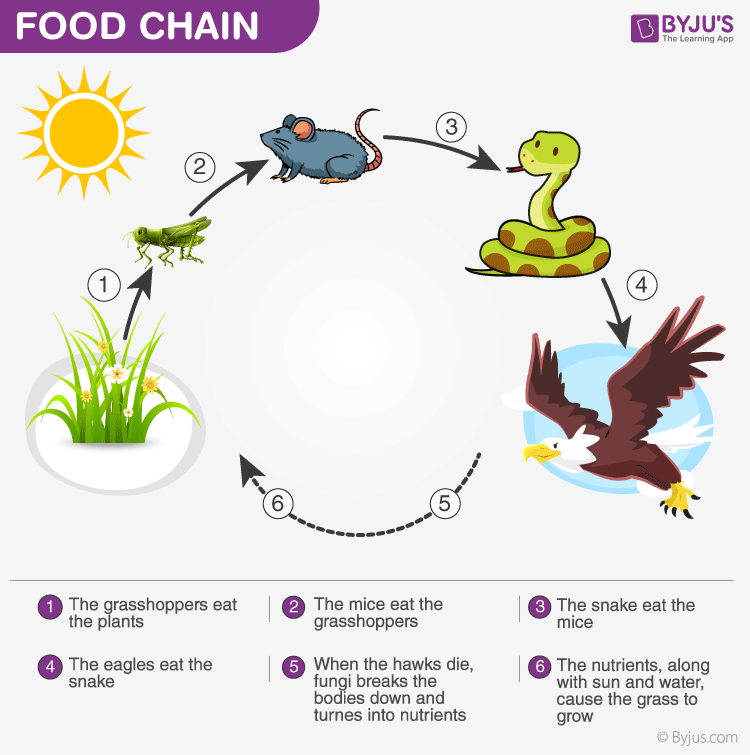
Explore more than: Deviation Between Food Chain And Food Spider web
Producers
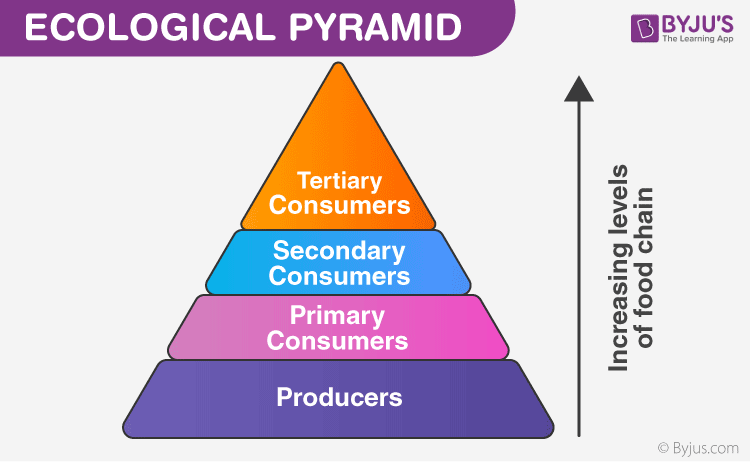
Organisms that can synthesize their ain food and unremarkably serve equally the foundation for all nutrient bondage. For example – plants, algae and few species of bacteria. They prepare their ain food by converting sunlight into chemical free energy and this process is chosen photosynthesis. They use energy from the sunlight for converting carbon dioxide into simple glucose which is easily broken down to produce energy. This energy is then stored in the form of sugars for later use.
The simple diagram of the Ecological Pyramid Food Web and Nutrient Concatenation is shown beneath.
Primary Consumers
They are also called herbivores animals who swallow producers or plants. Sometimes, these chief consumers become prey for other animals that sit down college on the food chain. Some of the principal consumers or herbivores living on the land are chipmunks, mice, horses, birds, deer and some insects. Fish, zooplankton, snails, sea urchins are a few marine primary consumers.
10 Pct Energy Rule
Even though chief consumers feed on producers, they are still getting their free energy from the sunday. The primary consumers feed on plants and break downwards the food particles to release the energy.
Primary consumers do not get 100% of the sun's energy from the producers or the plants on which they feed. This is considering just some amount of the lord's day'due south energy is utilised past the plant to synthesise their food.
In fact, they only go ten% of the energy. This is termed as the x% Rule, which states that just x per cent of the free energy available gets passed onto the next level of consumers.
Secondary Consumers
These are animals who feed on principal consumers. They unremarkably swallow meat and are termed as predators. Panthera leo, hawks, snakes, coyotes, wolves, and spiders are a few terrestrial secondary consumers.
Tertiary Consumers
They are the ones who feed on secondary consumers. They are thus called the top predators. They are also termed as noon predators and accept no natural enemies. Naturally, you would assume that humans are at the top of the food chain, but they are not.
Why are Humans not at the top of the nutrient chain?
Scientists categorize the organisms on the food chain by trophic levels. A "Trophic level" means how far an organism is from the starting time (level 1) of the nutrient chain.
Predators that utilise a peak-downward control on organisms in their customs are often considered keystone species. Humans are non considered noon predators because their diets are typically different, although human trophic levels increase with the consumption of meat.
For example, plants are considered to be at trophic level 1, and the apex predators are usually placed at level 4 or five. According to scientists, humans are placed on a trophic level of 2.21.
For more detailed information about the food spider web, food chain, or any other related topics, explore at BYJU'S Biology.

Tertiary Consumers In The Tundra,
Source: https://byjus.com/biology/food-web/
Posted by: stonegared1969.blogspot.com
0 Response to "Tertiary Consumers In The Tundra"
Post a Comment